Key Takeaways
- Identity data in modern enterprises is scattered across Entra ID, Azure, PIM, Service Principals, Enterprise Applications and Managed Identities, making it nearly impossible to answer: Who can access what, right now?
- An IVIP solves this by unifying identity and access data, continuously discovering changes, mapping relationships, detecting dormant or risky permissions, and revealing attack paths and blast radius.
- IVIP doesn't replace IAM, IGA, or PAM tools. It fills the gaps, by providing the visibility, analytics, and actionable intelligence they lack.
- For Microsoft ecosystems, a native IVIP such as Apor.io provides end-to-end visibility without the complexity of multi-cloud platforms.
A New Category Is Emerging
In its 2025 Hype Cycle for Digital Identity, Gartner introduced the Identity Visibility and Intelligence Platform (IVIP) as a new category that "provides rapid integration and visibility for IAM-relevant data, typically paired with advanced analytics capabilities."
With less than 5% market penetration and 5–10 years predicted until mainstream adoption, IVIP is still early-stage, yet its potential is enormous. It represents a new way of thinking about identity security.
Not just as control, but as continuous understanding.
Organizations that adopt IVIP today are positioning themselves ahead of a curve that will soon define digital defense. In an identity-first world, seeing your access landscape clearly is the ultimate competitive advantage.
"Identity Visibility and Intelligence Platforms (IVIPs) provide rapid integration and visibility for IAM-relevant data, typically paired with advanced analytics capabilities, to deliver a unified view of identities, relationships, and security posture."
The Identity Blind Spot
Despite enormous investment in IAM tools, enterprises still struggle to answer one deceptively simple question: Who can access what?
Identity data is scattered across systems such as Entra ID, Azure, PIM, and service principals. IAM solutions were built to enforce policy, not to create a unified truth of actual permissions. As a result, visibility remains partial, and teams spend wasted time exporting logs and reconciling spreadsheets just to complete an audit.
Five Visibility Gaps That Undermine Security
That fragmentation introduces five systemic risks that undermine even mature IAM programs:
-
No single answer to "who can access what"
Each portal tells only part of the story. Without a single view across systems, there's no way to see how permissions interact, or where exposure accumulates.
-
No real-time intelligence
Most IAM dashboards show what should be allowed, not what is currently active. Dormant accounts, outdated roles, and unintended overlaps go unnoticed until after an incident.
-
Identity sprawl creates invisible risk
Over time, environments fill with users, enterprise applications, guest accounts, and managed identities left behind by projects or acquisitions. Each one is a potential door left open.
-
Point-in-time reviews miss cloud reality
Quarterly or annual access reviews give a snapshot of yesterday. In fast-moving cloud environments, permissions can change in a more rapid pace, leaving reviews obsolete the moment they're completed.
-
Unknown blast radius
When a credential is compromised, most teams can't instantly assess what that identity could access. Without that context, risk prioritization and response are largely guesswork.
These visibility gaps don't just make audits painful. They quietly erode security posture and readiness for breaches. They're the blind spots attackers exploit first.
Related Reading
What Identity Sprawl Means for Digital SecurityDefining the IVIP
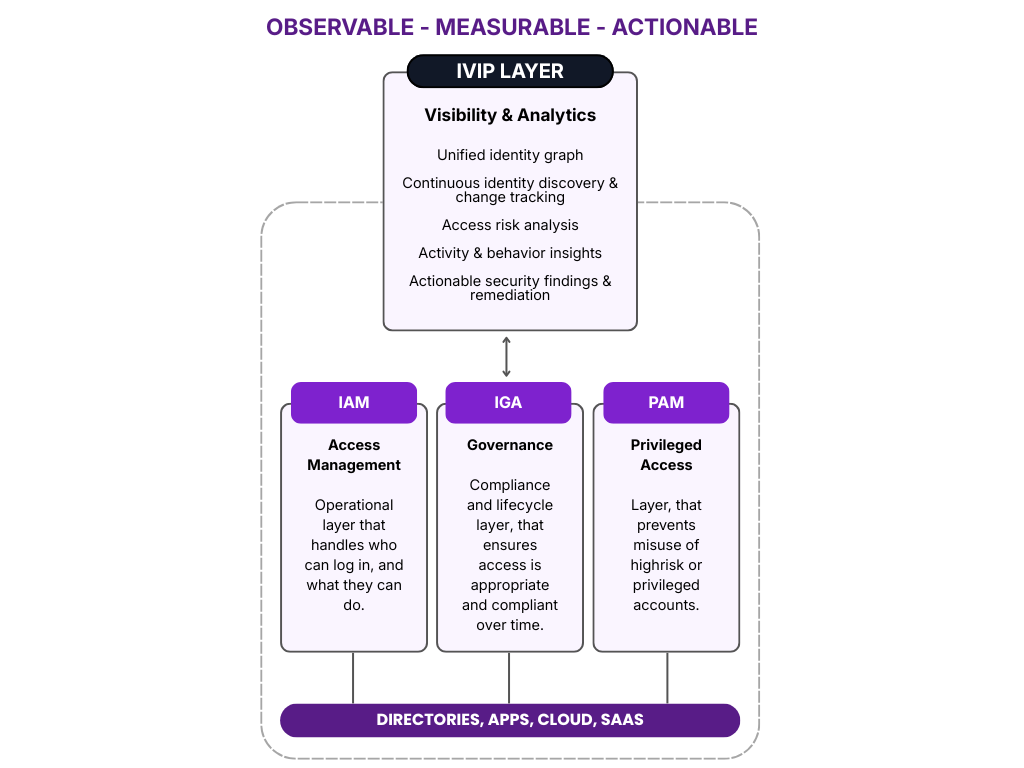
An Identity Visibility and Intelligence Platform acts as an intelligence layer above your existing IAM stack. Instead of replacing your IAM, IGA, or PAM tools, it fills the gap between and around them, normalizing and correlating identity data into one cohesive view.
By continuously discovering identities and analyzing their relationships, an IVIP delivers automated identity discovery and change tracking, giving teams real-time insight into how access evolves across systems.
It reveals how people, permissions, and resources connect across your identity fabric. It doesn't just show who should have access, but who does have access. And whether that access is used responsibly.
This unified visibility allows security teams to detect dormant permissions, monitor privilege escalation paths, and understand the true reach of every identity in real time.
Common IVIP Use Cases
- Dormant or orphaned account detection: Spot accounts no longer in use, reducing attack surface instantly.
- Excessive privilege identification: Pinpoint over-privileged admin roles or toxic combinations before they cause incidents.
- Blast radius & attack path mapping: Visualize how a compromised identity could move laterally across systems.
- Audit readiness: Replace manual reviews with automatically validated, up-to-date data.
- Privilege usage insights: Track which roles are actually activated and which sit unused.
The Shift to Identity-First Security
Cloud adoption has inverted traditional security models. The network is no longer the perimeter, the identity is. Attackers increasingly bypass technical controls and exploit the weakest link in the identity fabric: excessive access.
IVIP addresses this challenge head-on by turning visibility into defense. It continuously correlates data across systems, giving teams a living map of identity relationships and potential attack paths.
That means instead of discovering exposure after a breach or audit, you can find and fix it before it's exploited. This is the essence of identity-first security: protecting what people can do, not just where they log in.
How IVIP Complements Existing IAM
Rather than competing with IAM, IVIP makes it more effective.
With IGA (Identity Governance & Administration)
IVIP validates governance assumptions with real-time evidence, showing what access exists today. Not just what was approved months ago.
With PAM (Privileged Access Management)
IVIP adds visibility into how privileges are distributed and used, identifying patterns of persistent standing access.
With Access Management
IVIP links authentication data to entitlements, showing how identities span across domains and systems.
Together, these integrations create a feedback loop: governance, enforcement, and intelligence reinforcing each other for continuous control.
Business Outcomes That Matter
The impact of IVIP adoption is measurable across both security and operational dimensions.
Organizations report faster audits, simpler investigations, and greater confidence in their compliance posture. But beyond process efficiency, IVIP drives a deeper strategic shift: from uncertainty to assurance.
- Time saved: Automated collection and correlation eliminate weeks of manual effort.
- Risk reduction: Dangerous combinations and dormant permissions are found and removed before incidents occur.
- Compliance confidence: Audit trails and reports are continuously updated, verified, and ready on demand.
- Operational efficiency: Security teams gain instant insight into real-world access without disrupting business users.
- Security findings: IVIP correlates permissions, activity, and anomalies, surfacing actionable security findings that inform prioritization and remediation.
- ROI in maturity: Less time spent gathering data means more time mitigating risk and strengthening controls.
This combination of clarity and speed gives security leaders the power to make decisions based on truth, not assumption.
Key Benefits at a Glance
- Unified, continuously updated view of all identities
- Automated identity discovery and change tracking
- Real-time visibility into permissions and risk exposure
- Cross-domain correlation for complete identity context
- Actionable security findings and analytics for prioritization
- Seamless integration with existing IAM tools and processes
The Early Adopter Advantage
Every few years, a new capability reshapes enterprise security. In the 2010s, it was Privileged Access Management. In the 2020s, it's IVIP.
Gartner's timeline shows full adoption may take up to a decade, but the security challenges IVIP solves are already urgent. Early adopters gain not just maturity, but measurable resilience: faster detection, reduced exposure, and stronger audit posture.
For enterprises built on the Microsoft ecosystem, the advantage compounds. Apor.io delivers IVIP capabilities purpose-built for Entra ID and Azure, providing unified visibility and continuous intelligence without multi-cloud overhead.
It's the clearest path to understanding and controlling your identity ecosystem end to end, in real time.